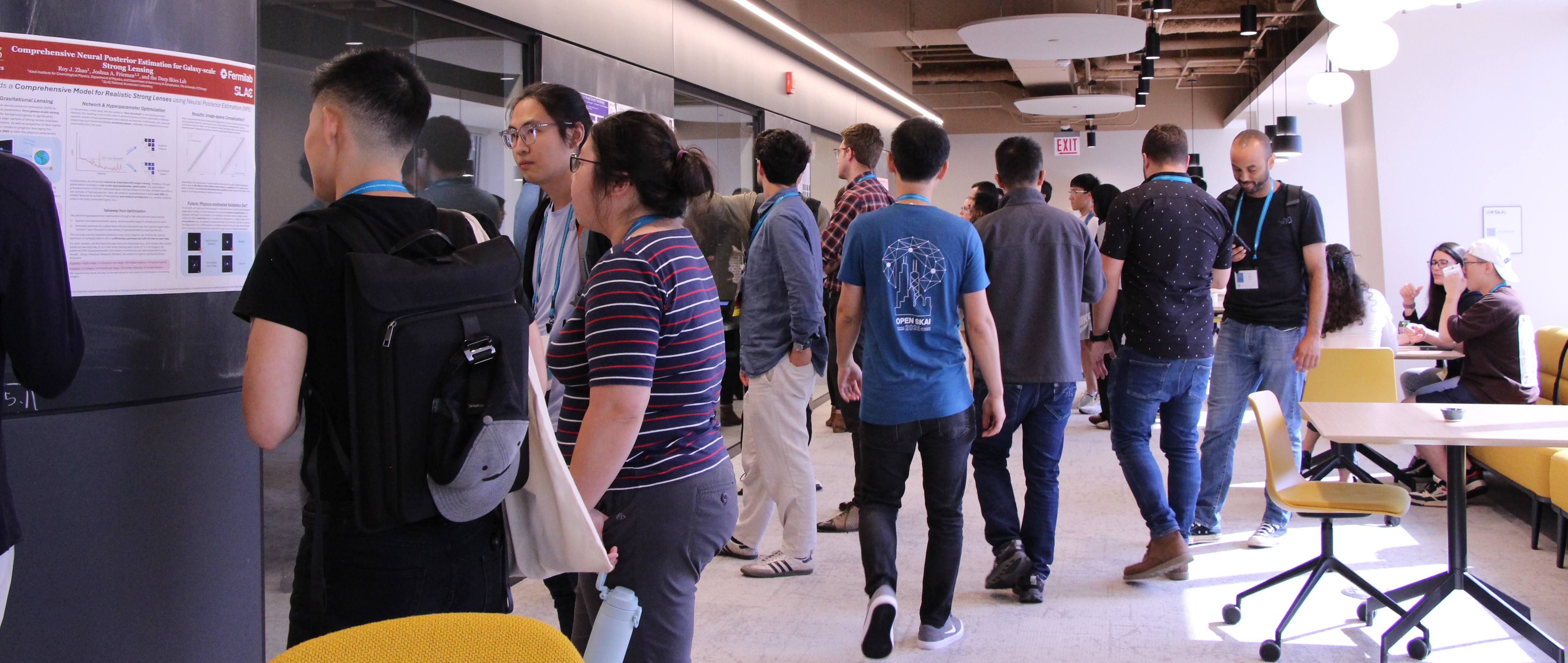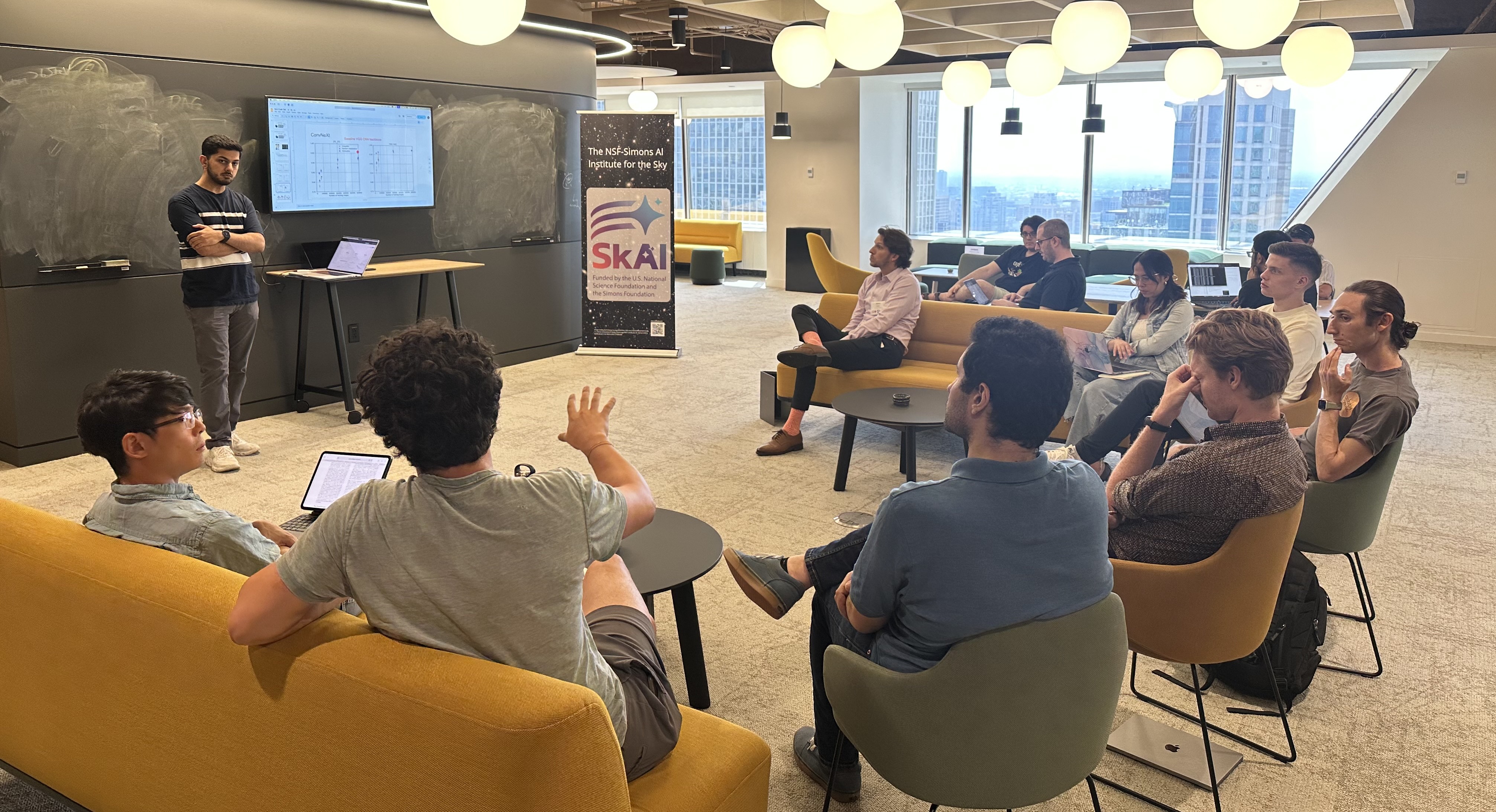
The workshop is structured to maximize collaboration and discussion
Welcome and Introduction
Building Benchmarks
On-going Research
Synthesis and Planning
| Time | Session | Speaker/Details |
|---|---|---|
| 09:00 - 09:30 | Registration & Coffee | SkAI Institute Cafe |
| 09:30 - 10:00 | Welcome Remarks & Goals and Outline for the Workshop | Adam Miller |
| 10:00 - 10:30 | Invited Talk: The ZTF Bright Transient Survey Data Set | Christoffer Fremling |
| 10:30 - 11:00 | Coffee Break | |
| 11:00 - 11:30 | Invited Talk: PLASTICC, ELASTICC, and Lessons Learned From Simulated LSST Light Curves | Alex Malz |
| 11:30 - 12:00 | DISCUSSION: What makes a good benchmark data set? | Discussion leads: TBD |
| 12:00 - 13:30 | Lunch | |
| 13:30 - 14:00 | DISCUSSION: What taxonomy makes sense for *real* data? | Discussion leads: TBD |
| 14:00 - 14:15 | Scalable time-domain science with LSDB framework and HATS catalog format | Kostya Malanchev |
| 14:15 - 14:30 | Sub-Second Transient Detectability with Deep Learning and Continuous-Readout Imaging | Shar Daniels |
| 14:30 - 14:45 | High-Cadence Transient Discovery with the Argus Array | Jon Carney |
| 14:45 - 15:00 | Pre-trained Vision Models Enabling Scalable Image Encoding for Massive Alert Streams | Nabeel Rehemtulla |
| 15:00 - 15:30 | Coffee Break | |
| 15:30 - 16:00 | DISCUSSION: The growing importance of multi-modality for Rubin/LSST. What data should supplement BTS light curves? | Discussion leads: TBD |
| 16:00 - 16:30 | DISCUSSION: metrics - how do we ensure holistic scientific output, and not "p-hacking" to make a single number as large as possible? | Discussion leads: TBD |
| 16:30 - 16:45 | The Open mulTiwavelength Transient Event Repository (OTTER): A tool for curating time domain datasets | Noah Franz |
| 16:45 - 17:00 | The Need for a Light Curve Interpolation and Forecasting Benchmark Dataset | Siddharth Chaini |
| Time | Session | Speaker/Details |
|---|---|---|
| 09:30 - 10:00 | DISCUSSION: What is an "anomaly" and can they be incorporated into this benchmark? | Discussion leads TBD |
| 10:00 - 10:30 | Invited Talk: HuggingFace, data prep, building legacy data sets in astronomy | TBD |
| 10:30 - 11:00 | Coffee Break | |
| 11:00 - 12:00 | Parallel working sessions: (i) light curves, (ii) host galaxies, (iii) cutouts, (iv) anomalies | |
| 12:00 - 13:30 | Lunch | |
| 13:30 - 15:00 | Parallel working sessions | |
| 15:00 - 15:30 | Coffee Break | |
| 15:30 - 15:45 | Poster Lightning Talks | Poster Presenters |
| 15:45 - 16:30 | Poster Session | All Participants |
| 16:30 - 17:00 | Working group share backs | Parallel session reporters |
| Time | Session | Speaker/Details |
|---|---|---|
| 09:30 - 09:45 | Anomaly detection with AppleCiDEr | Argyro Sasli |
| 09:45 - 10:00 | ORACLE: A Real-Time, Hierarchical, Multi-Modal Photometric Classifier for ZTF and LSST | Ved Shah |
| 10:00 - 10:15 | Attention-Based Preprocessing Framework for Improving Rare Transient Classification | Xinyue Sheng |
| 10:15 - 10:30 | Simulating realistic ZTF events using LightCurveLynx | Mi Dai |
| 10:30 - 11:00 | Coffee Break | |
| 11:00 - 12:30 | Parallel working sessions: (i) light curves, (ii) host galaxies, (iii) cutouts, (iv) anomalies | |
| 12:30 - 14:00 | Lunch | |
| 14:00 - 15:00 | Parallel working sessions | |
| 15:00 - 15:30 | Coffee Break | |
| 15:30 - 16:30 | Poster Session | All Participants |
| 16:30 - 17:00 | Working group share backs | Parallel session reporters |
| 17:30 | Workshop Reception and Dinner | SkAI Hub |
| Time | Session | Speaker/Details |
|---|---|---|
| 09:30 - 10:00 | DISCUSSION: what do (future) classification models need that is currently absent from existing models (& can we incentivise this in the Benchmark) | Discussion leads TBD |
| 10:00 - 11:00 | Parallel working sessions wrap up | |
| 11:00 - 11:30 | Coffee Break | |
| 11:30 - 12:00 | Closing Remarks and Meeting Summary (Workshop Concludes) | Adam Miller |
Contributed talks will be short and focused on the benchmark. Please submit your abstract by February 6, 2026 for consideration.
Posters should be A0 size (portrait orientation). Poster boards and materials will be provided.
Participants will be assigned to working groups based on their expertise and interests indicated during registration.